







- Browse Categories
- FRP Product
- Plastic Product
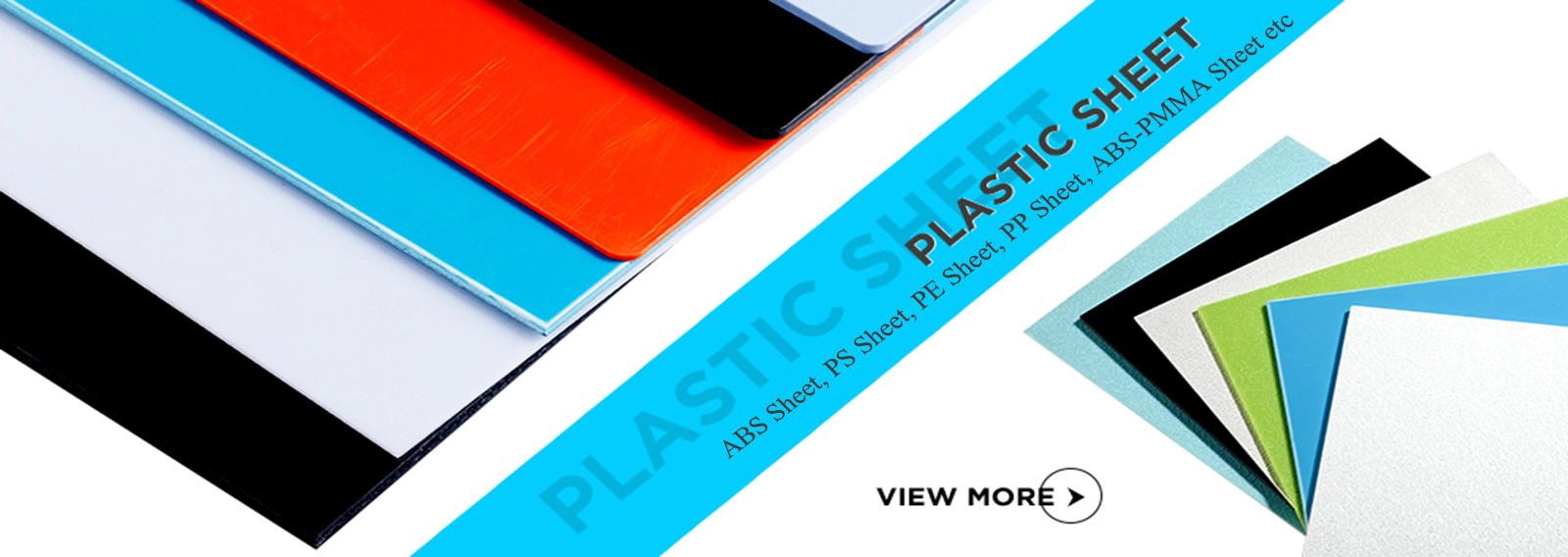
- ABS Sheet
- HIPS Sheet
- PP Sheet
- HDPE Sheet
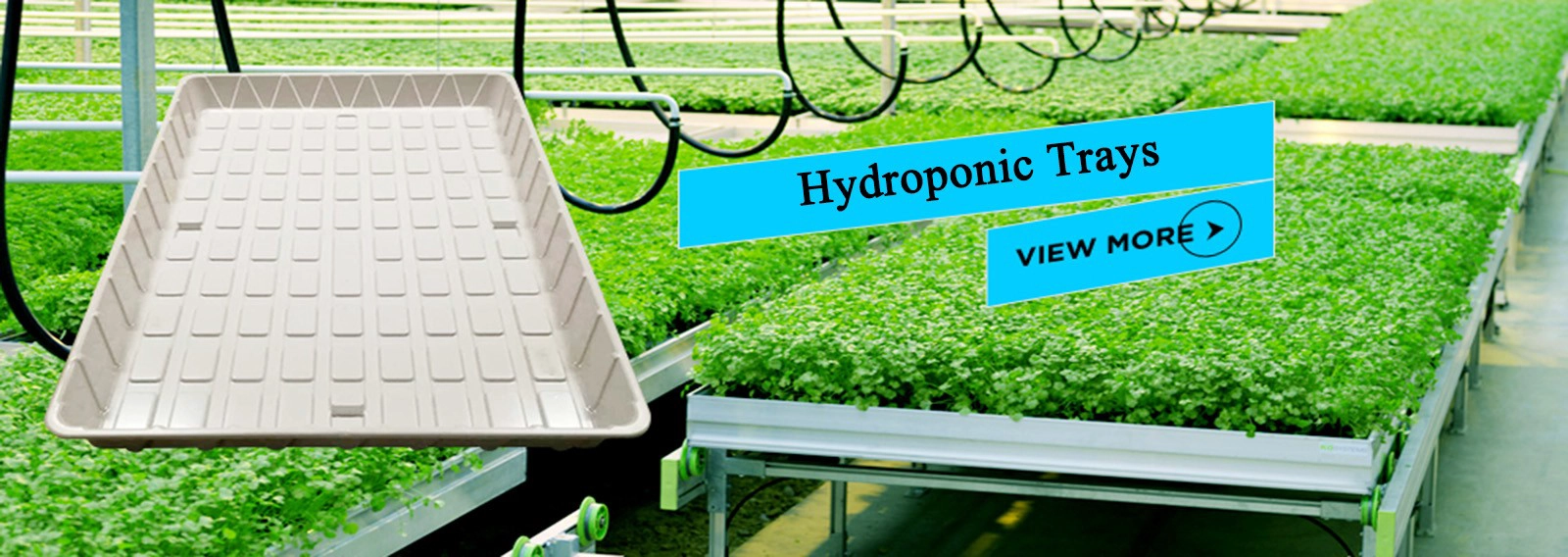
- Hydroponic Tray
- Vacuum Forming Processing
- Subscribe
-
Get email updates on new products
- Contact Us
-
Telephone: +86-0755-28329102
Mobile Phone: +86-15814411453
Fax: +86-755-28998345
Address:Room 02, 32 Floor, 6 block, Phase 3, Xieli Garden, Longcheng Street, Longgang District, Shenzhen
Zip:518172
Country/Region:China (Mainland)
Province/State:Guangdong
City:Shenzhen Contact Now
- FRP Product
- News
-
How to Choose Refrigerated Truck Body Panels
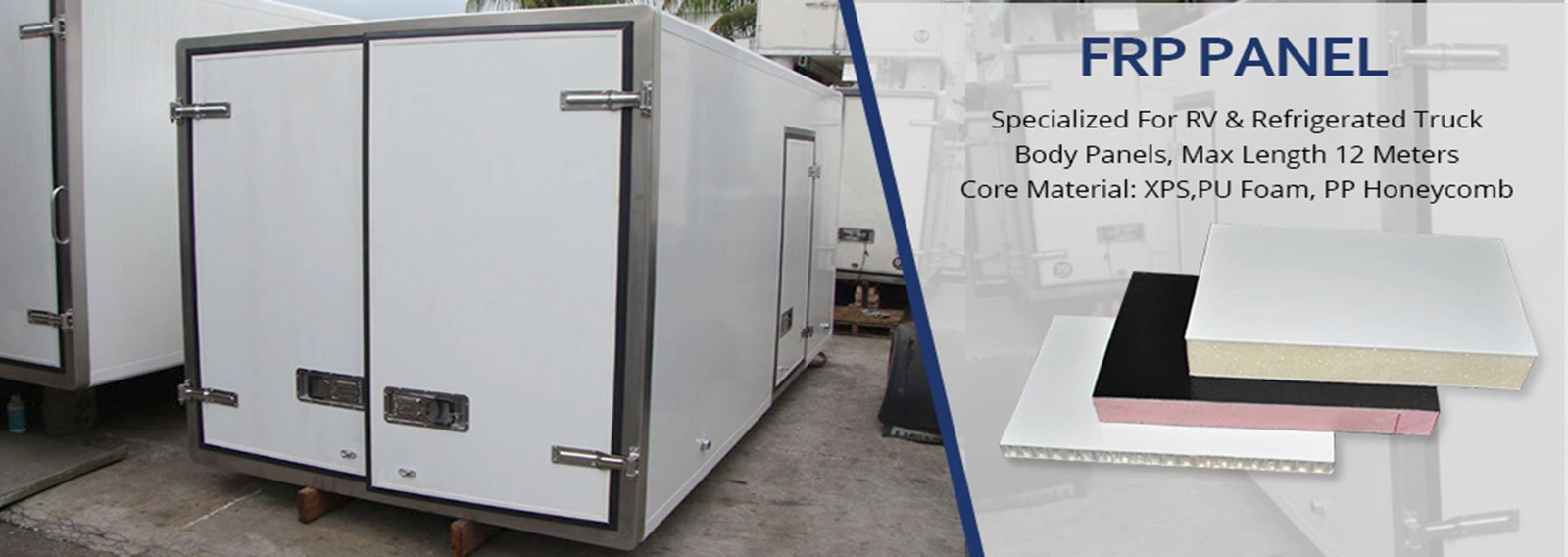
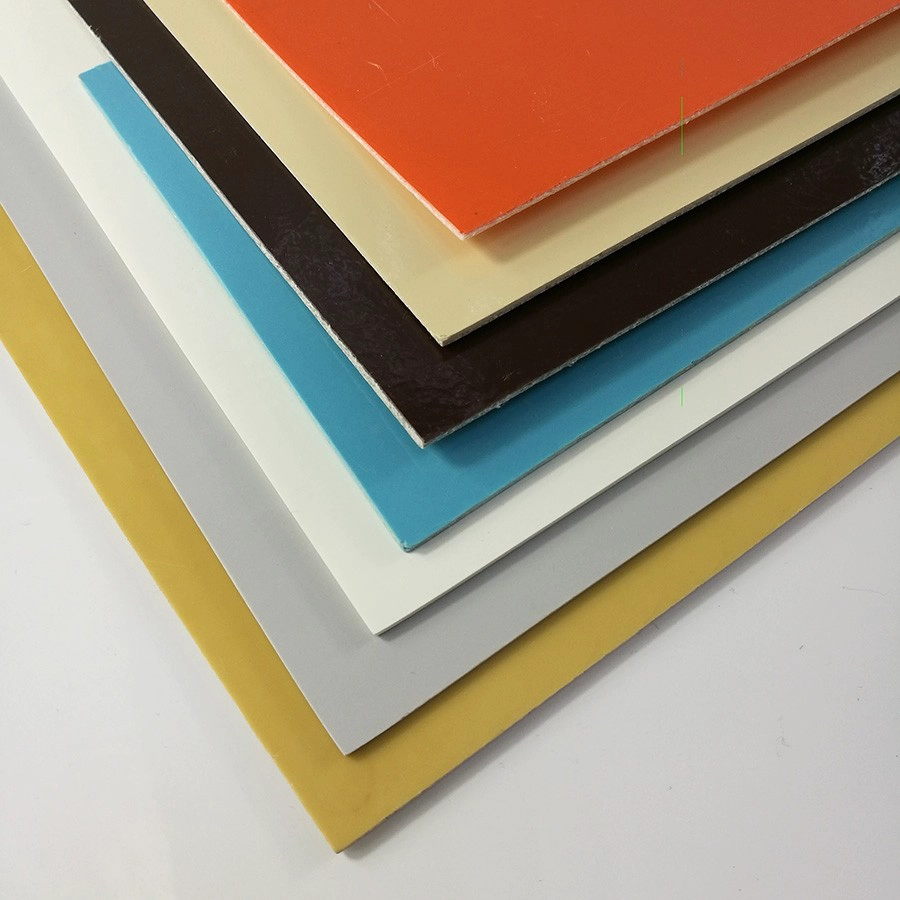
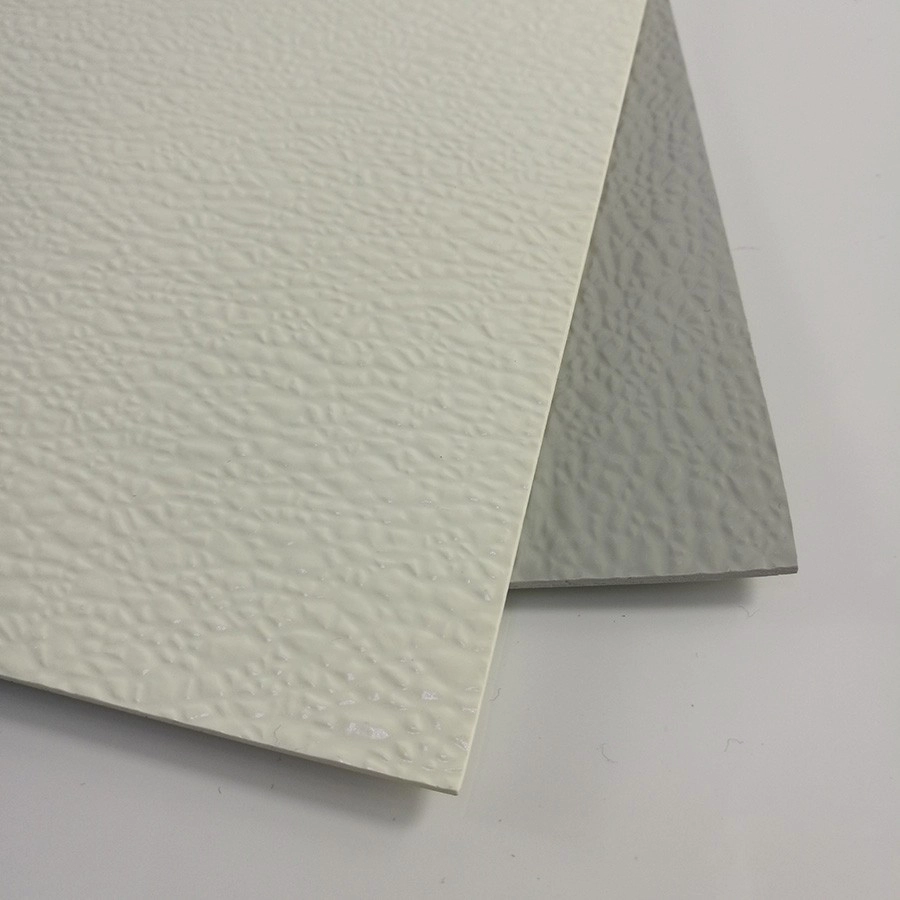
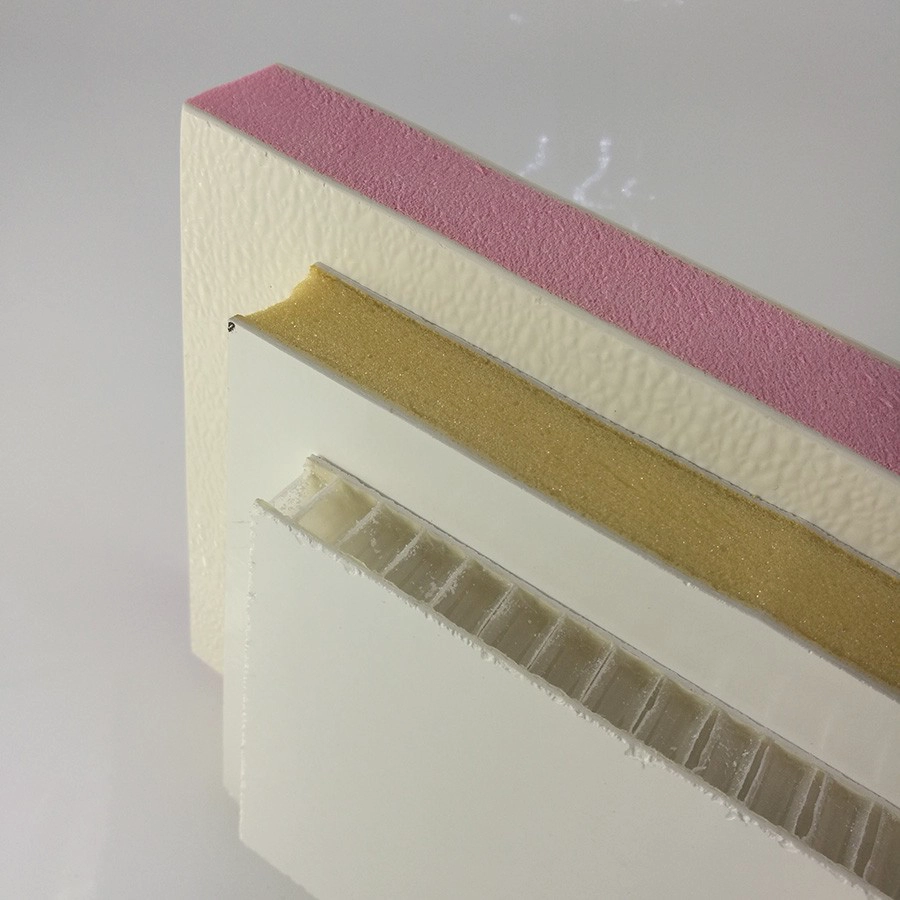
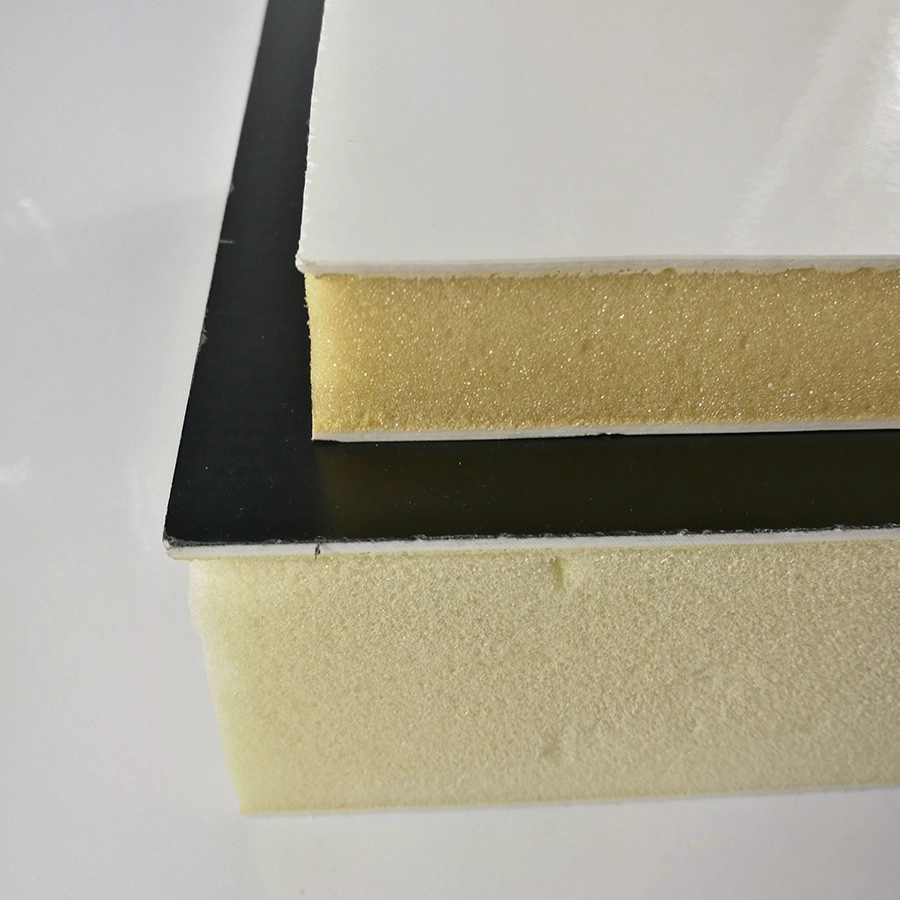
Due to cost, installation and construction, the refrigerated truck van panels were gradually made of FRP composite panels. FRP composite panels are made of FRP flats and used as two layers of the bottom and the top, in addition to the role of controlling the weight, and also have good impact resistance. The middle layer uses different kinds of core materials, such as PP honeycomb core material, XPS core material, PU core material, etc.,The differences between FRP mechanism sheet and Hand Lay-up sheets
At the beginning of the industry, manpower was usually used to make FRP, but most manufacturers use production line to produce FRP sheet now. FRP mechanism sheet gradually replaced hand lay-up sheet. The FRP mechanism sheet has many advantages over the hand lay-up. The FRP mechanism plate has stable quality and uniform thickness. Cost-effective, neat and shiny surface.Hydroponics Overview Technique and Advantages
1) Hydroponic OverviewHydroponics is a new type of plant soilless culture method, also known as nutrient solution culture. Its core is to directly inf...ABS Sheet Performance and Applications
ABS sheet is an emerging material in the plastic sheet industry. The full name is Acrylonitrile butdiene styrene. It is a polymer with a relatively la...Can Flame-retardant Fiberglass Lighting Roofing Panels Be Still Used After Yellowing?
A, Fire-retardant FRP lighting roofing panels are mainly used in steel mills and blast furnaces with high temperatures, fire point splashes or some sp...RV Traveling Are Getting More and More Popular
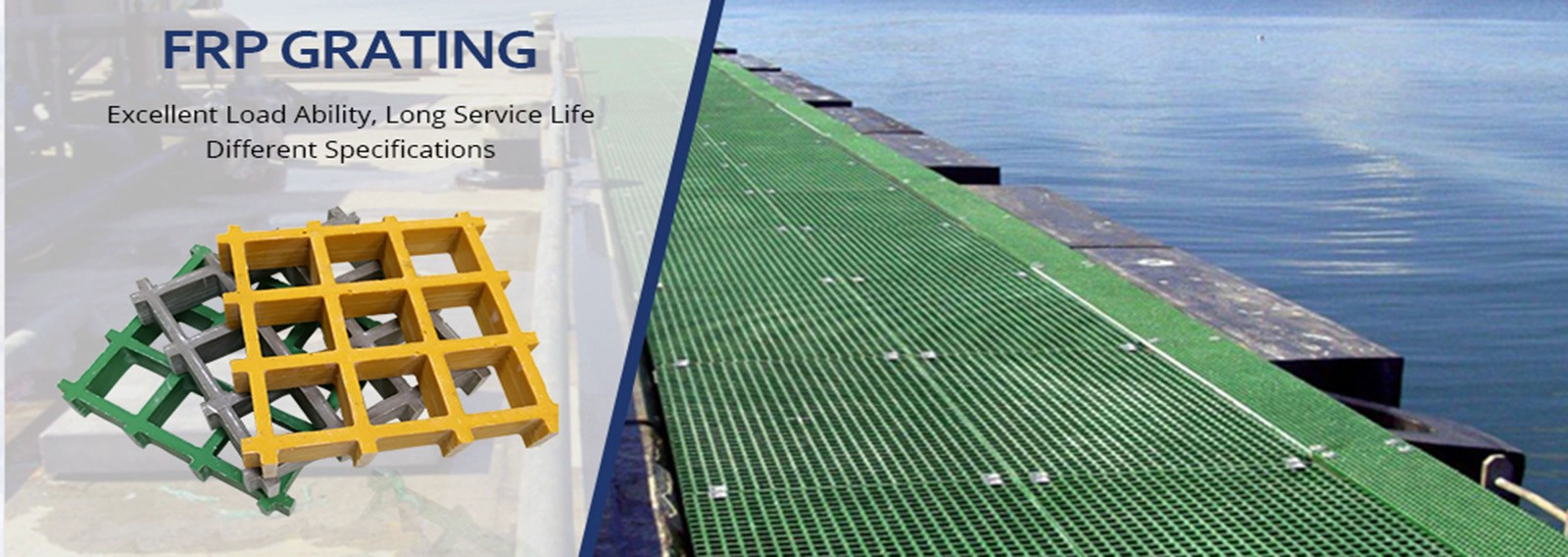
Do you know what a RV is? The concept of the beginning of RV is “movable house”. The RV has all the necessary items for life, including bedr...Fibre Reinforced Plastic (FRP) Grating Description
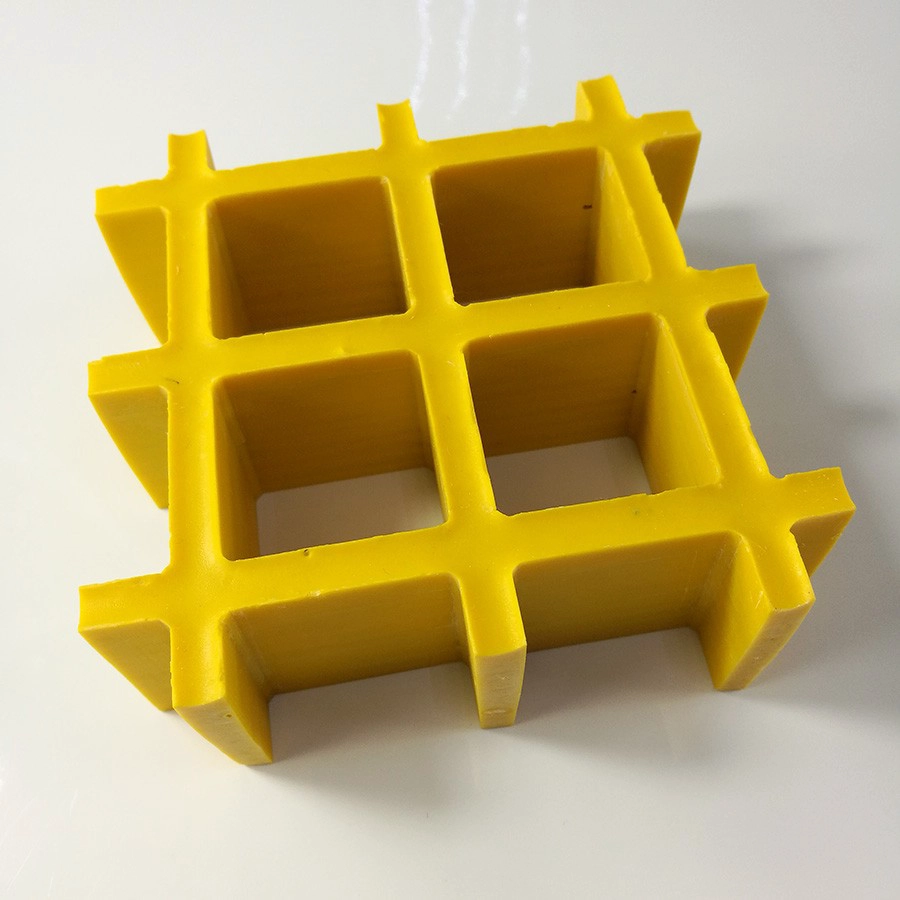
The Fibre Reinforced Plastic (FRP) grating is a moulded, one-piece fibreglass reinforced plastic grating, available in standard panels or fabricated i...FRP Sheet & Panel Project
FRP Gratings Applications
Thanks of the excellent properties of FRP gratings, they are replacing carbon steel, stainless steel, wood and non-ferrous metals. The fiberglass gra...FORE PP Sheet for Tanks
FORE PP Sheet for Tanks Foreth PP Sheet has good acid and alkali resistance properties,excellent welding processability and non-toxic environmental ...
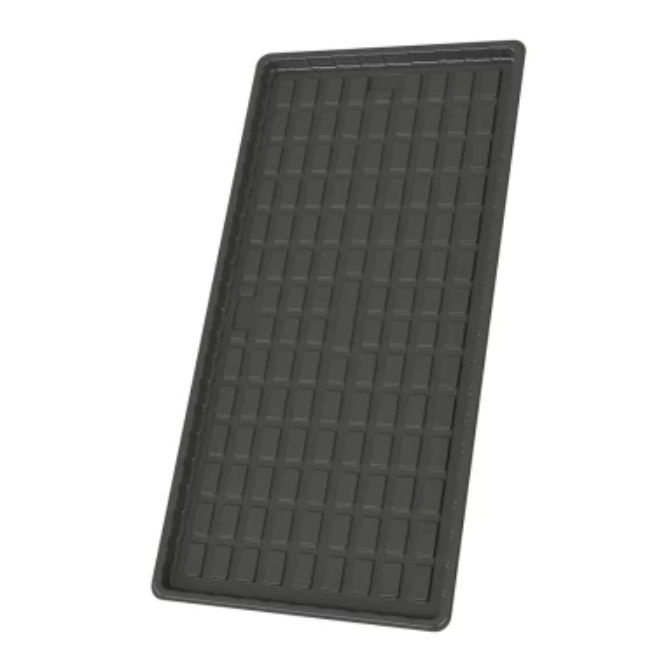
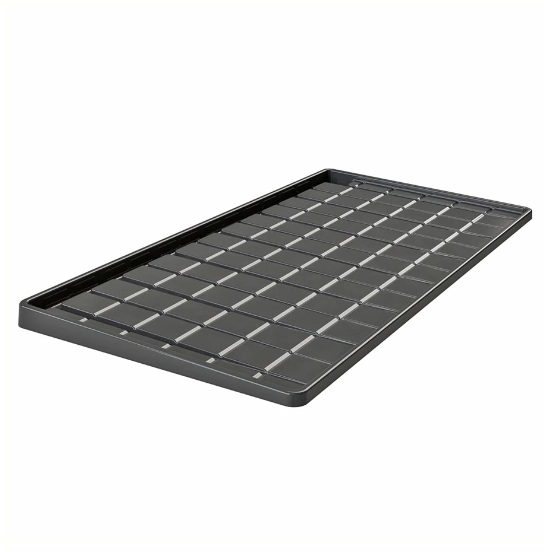
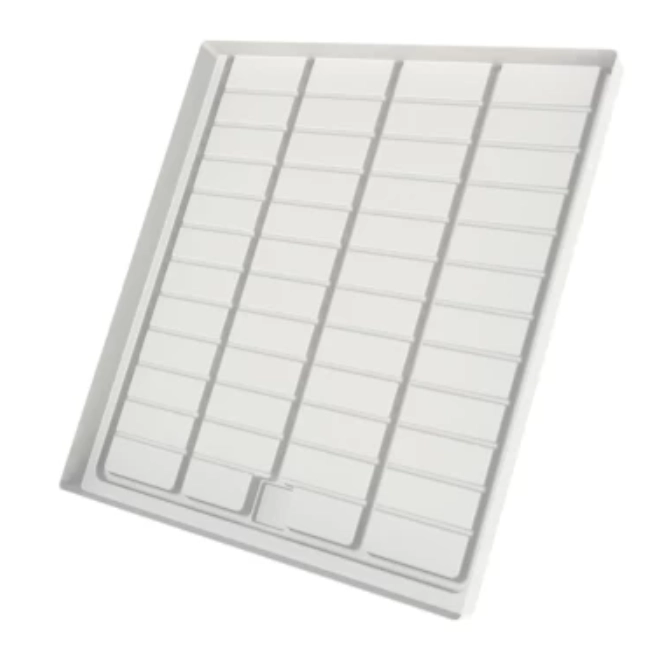
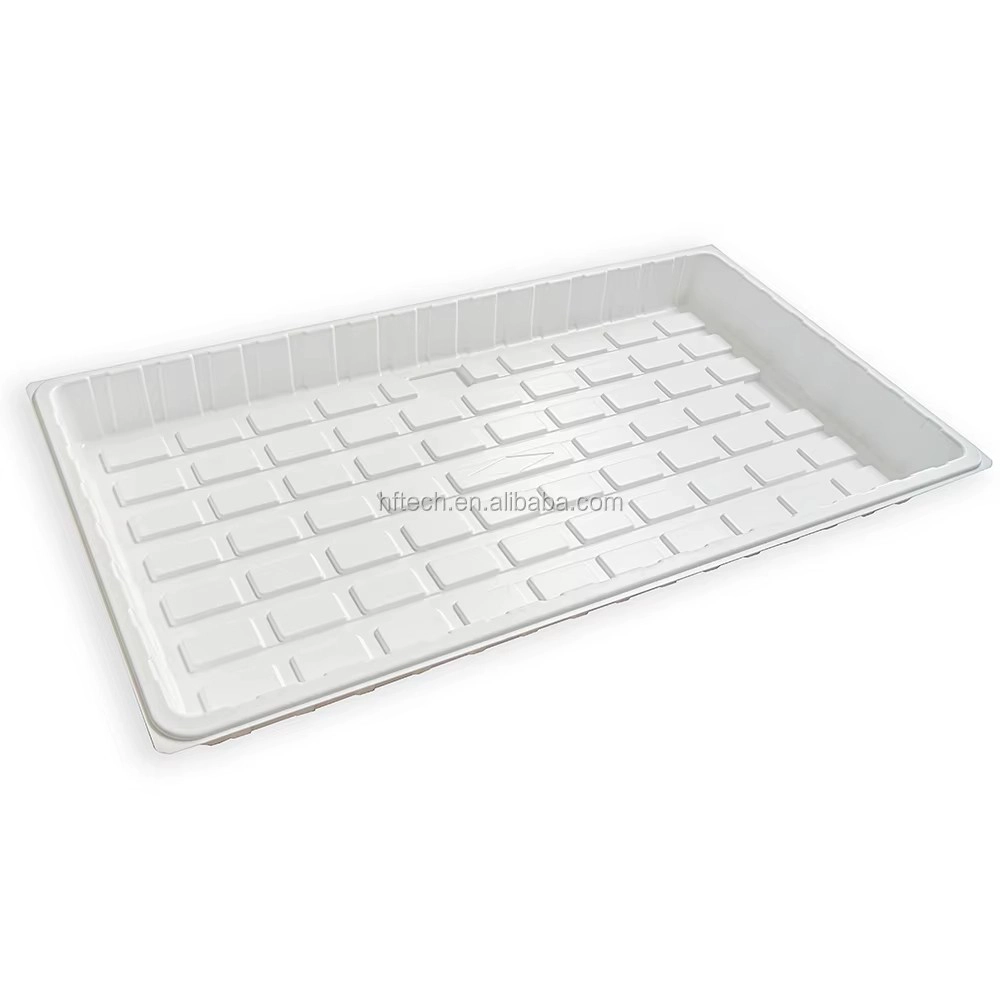
Thermoformed ABS Ebb-and-Flow Trays: The Workhorse of Commercial Irrigation
- Type:Plastic Shed
- Size:Small
- Model Number:customized
- Place of Origin:Guangdong, China
- Brand Name:foreth
- Color:White, Black, customized
- Thickness:3-8mm, customized
- Width:620mm,1200mm or customized
- Length:Infinity
- Hieght:80mm or customized
- Process:Vacuum Forming
- Name:Customize ABS Plastic Hydro Overlap Infinity Rolling Tray
- Commercial Buyer:Specialty Stores
- Room Space:Indoor and Outdoor
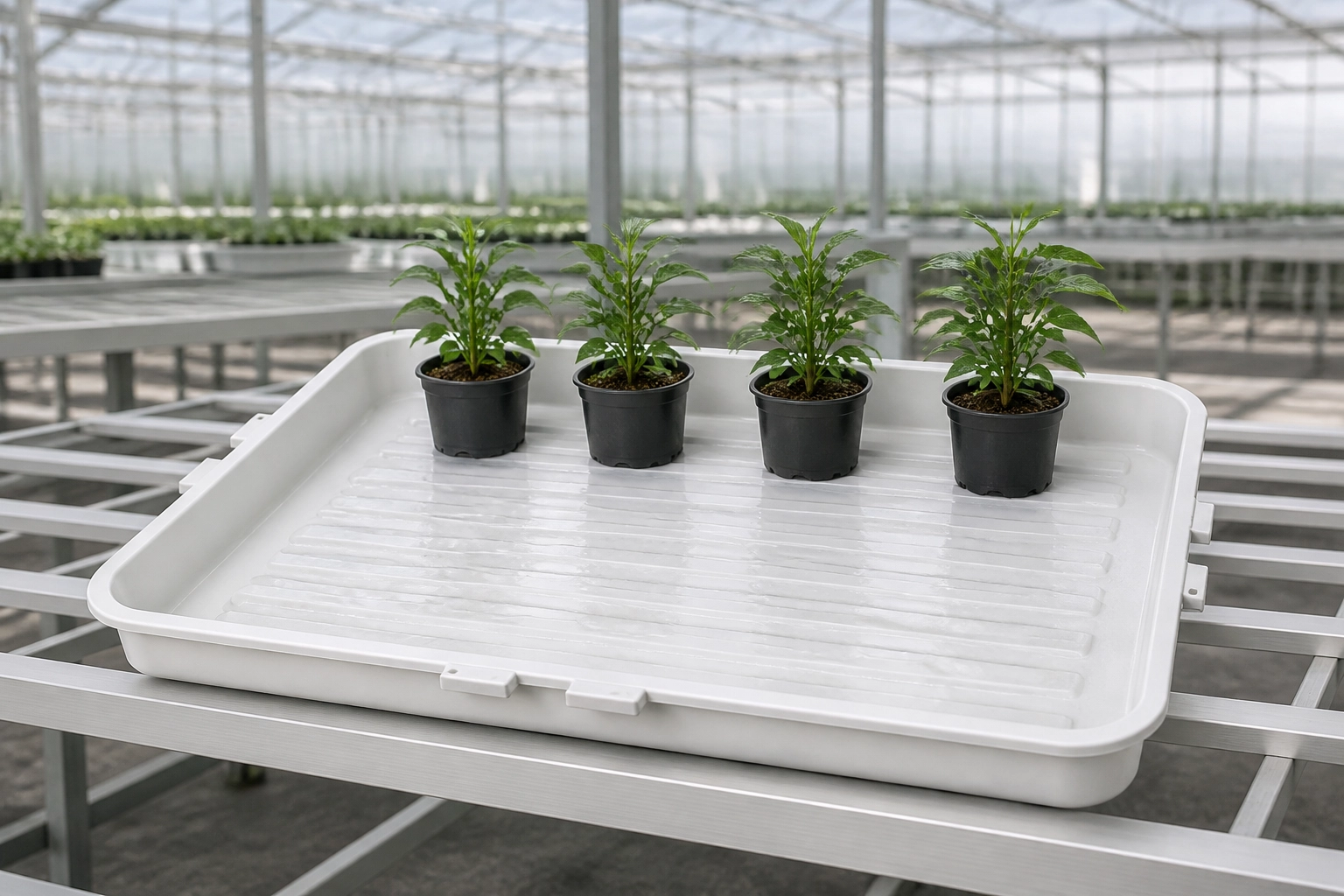
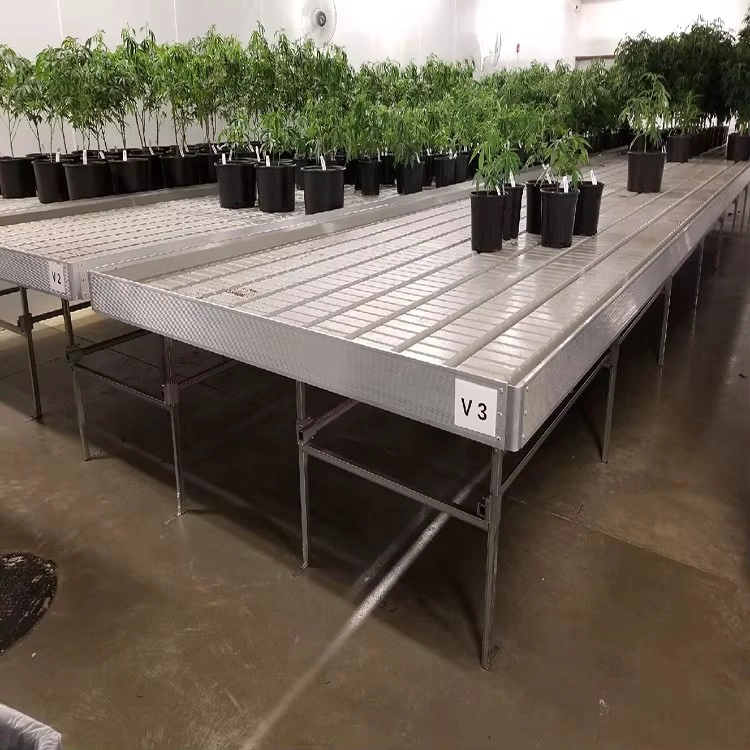
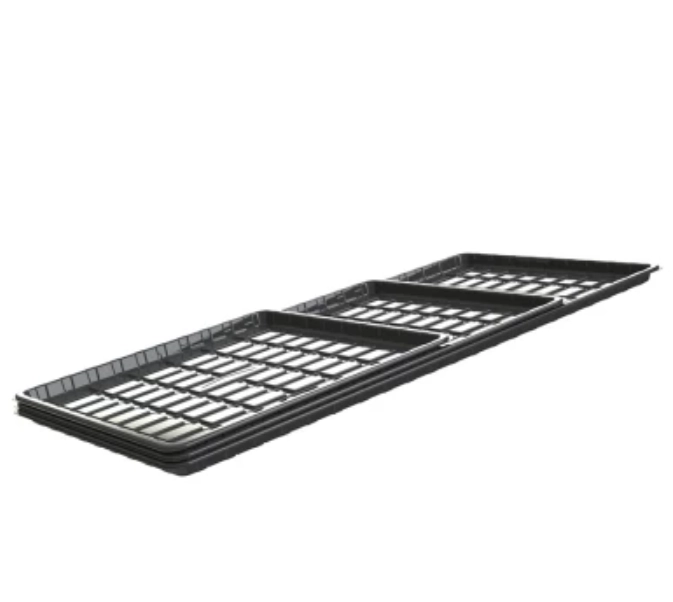
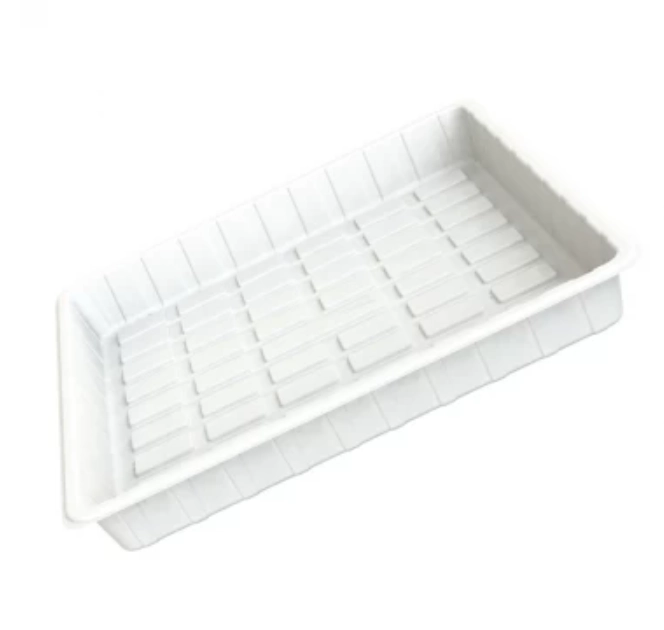
1. What Is an Ebb-and-Flow (Flood-and-Drain) Tray?
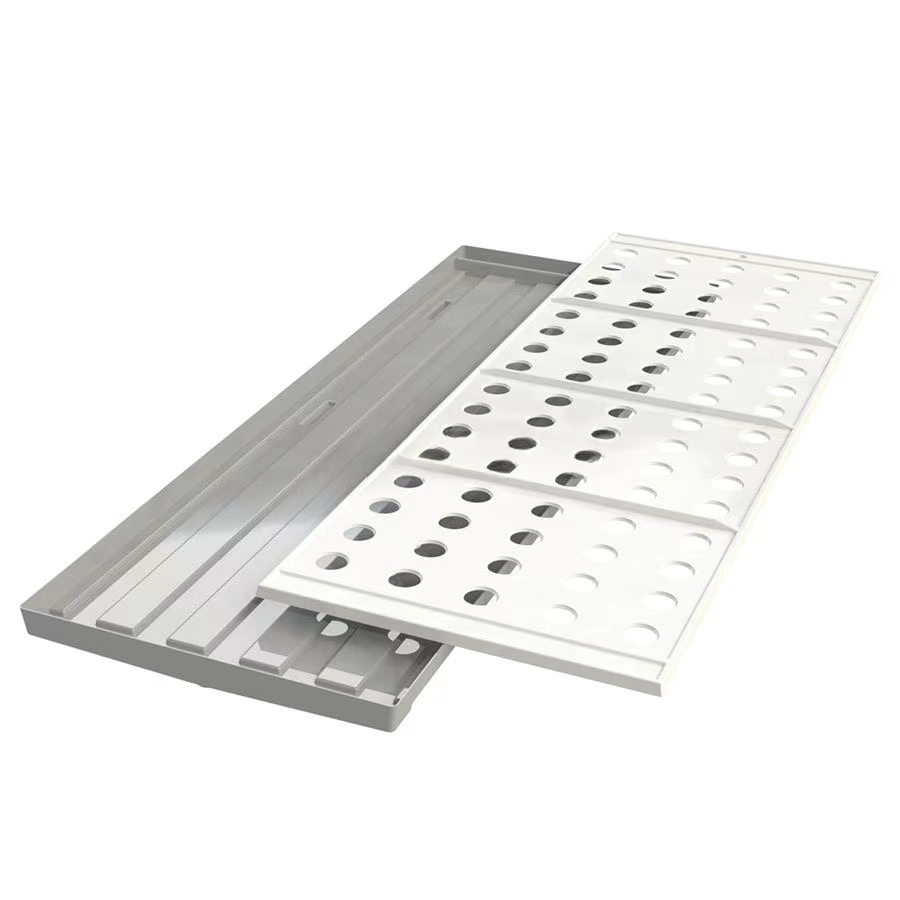
An ebb-and-flow tray is a shallow, watertight basin that sits on a greenhouse bench, rack or floor frame. A timer-controlled pump delivers nutrient solution from a reservoir into the tray; the solution soaks root zones from below, then drains back through the same fittings once the pump stops.
This flood-and-drain rhythm gives plants three things at every cycle:
Water and nutrients delivered evenly across the entire root zone
Fresh oxygen pulled into the root zone as the tray empties
No waterlogging — excess solution leaves the tray completely, preventing root rot and anaerobic zones
Because the tray is the interface between the irrigation system and the crop, its flatness, rigidity, drain geometry and material stability directly determine how uniform and reliable every cycle is.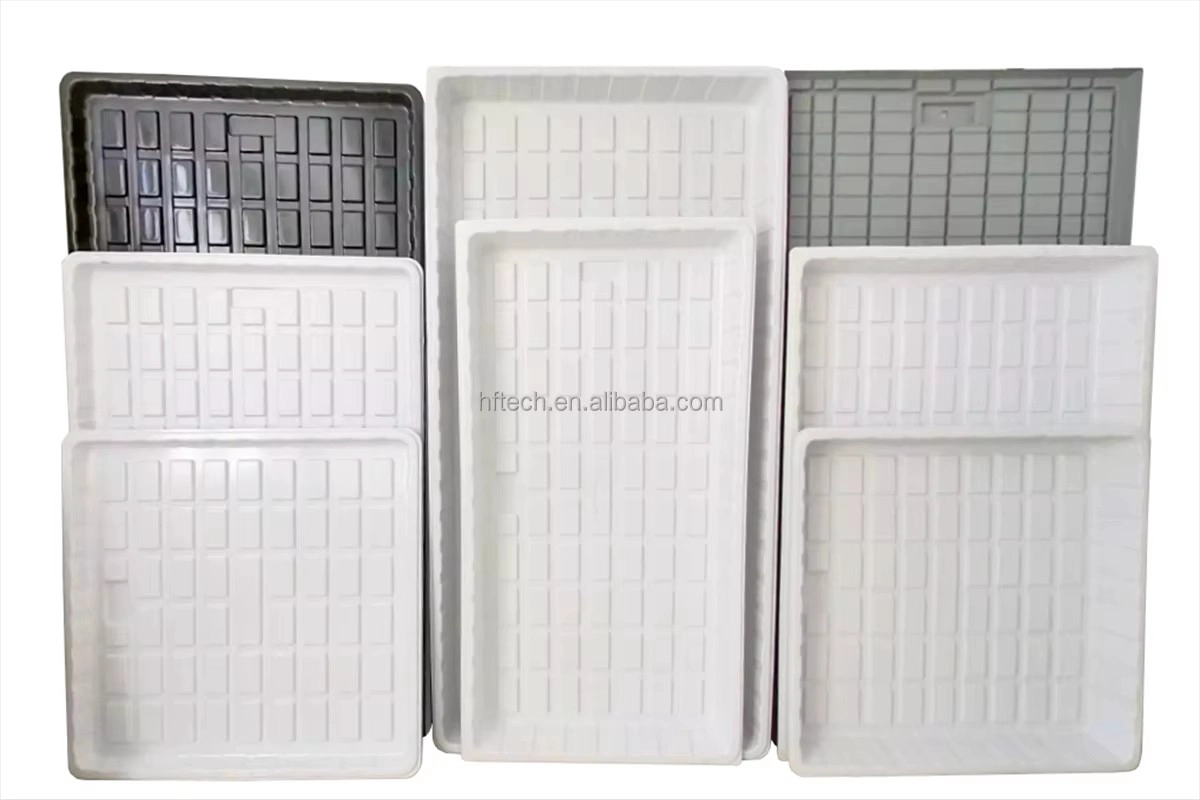
2. How Thermoformed ABS Trays Are Made
ABS flood trays are produced by vacuum thermoforming — heating a plastic sheet and drawing it over a mold. The process differs fundamentally from injection molding and delivers distinct engineering benefits.
Step 1 — Sheet extrusion (raw material)
ABS resin is compounded with pigments, UV stabilizers and impact modifiers, then extruded into continuous sheet of a controlled gauge. Producing the sheet in-house gives the factory full control over thickness tolerance, color consistency and material traceability.
Step 2 — Heating
The ABS sheet is clamped into a thermoforming machine and heated to its forming temperature. Even, controlled heating is critical: it relaxes internal stress in the sheet, which later translates into a dimensionally stable tray that will not warp under sun or load.
Step 3 — Vacuum forming
The heated sheet is drawn down over a machined aluminum mold by vacuum. The mold defines the tray's geometry — depth, corner radii, rib pattern and drain slopes. Because the mold is a single cavity, the finished tray is one seamless piece: no welds, no glued joints, no leak paths.
Step 4 — Trimming and finishing
The formed part is trimmed on a CNC router or trim press to exact outer dimensions. Drain openings are cut precisely, and edges are finished smooth or rolled to protect greenhouse floor films, benching liners and operators' hands.
Step 5 — Quality control
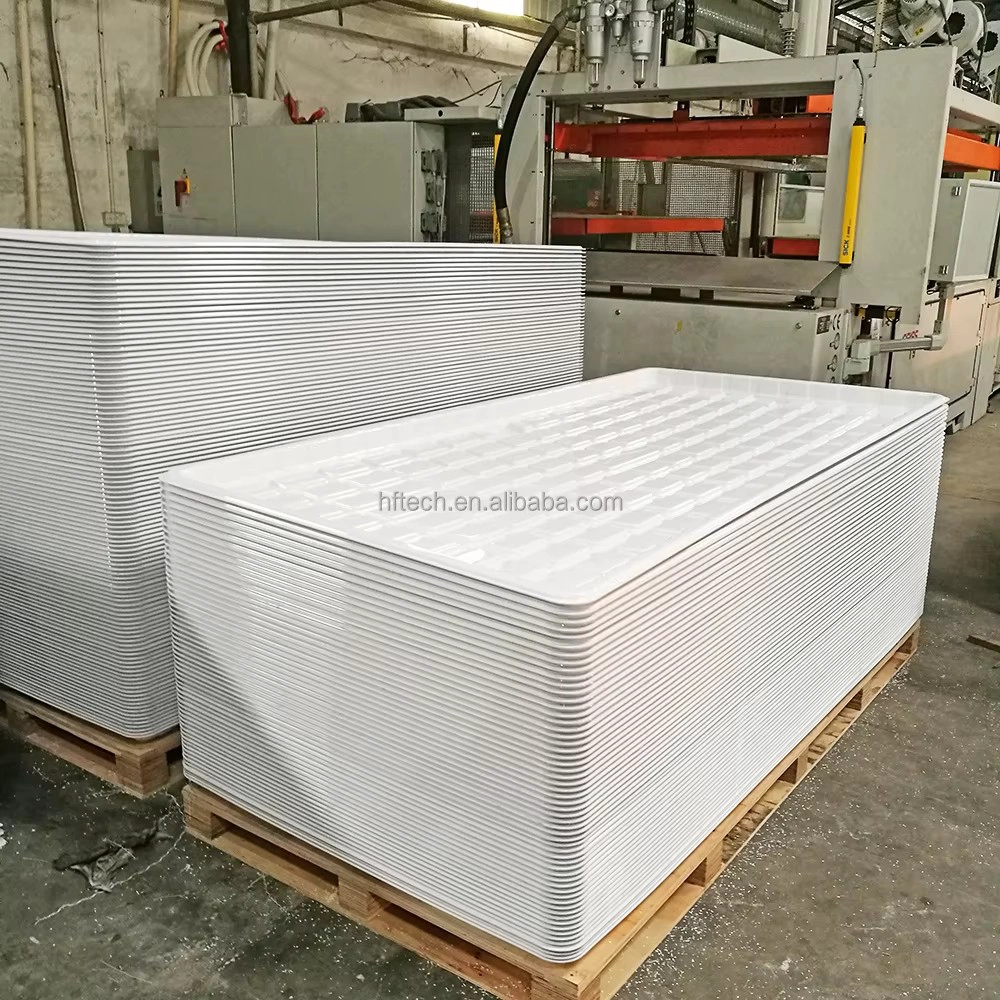
Finished trays are inspected for dimensional accuracy, wall-thickness distribution and surface defects. Random (or 100%, depending on specification) water-tightness and load checks are performed before packing. Trays are then nested for compact export packaging.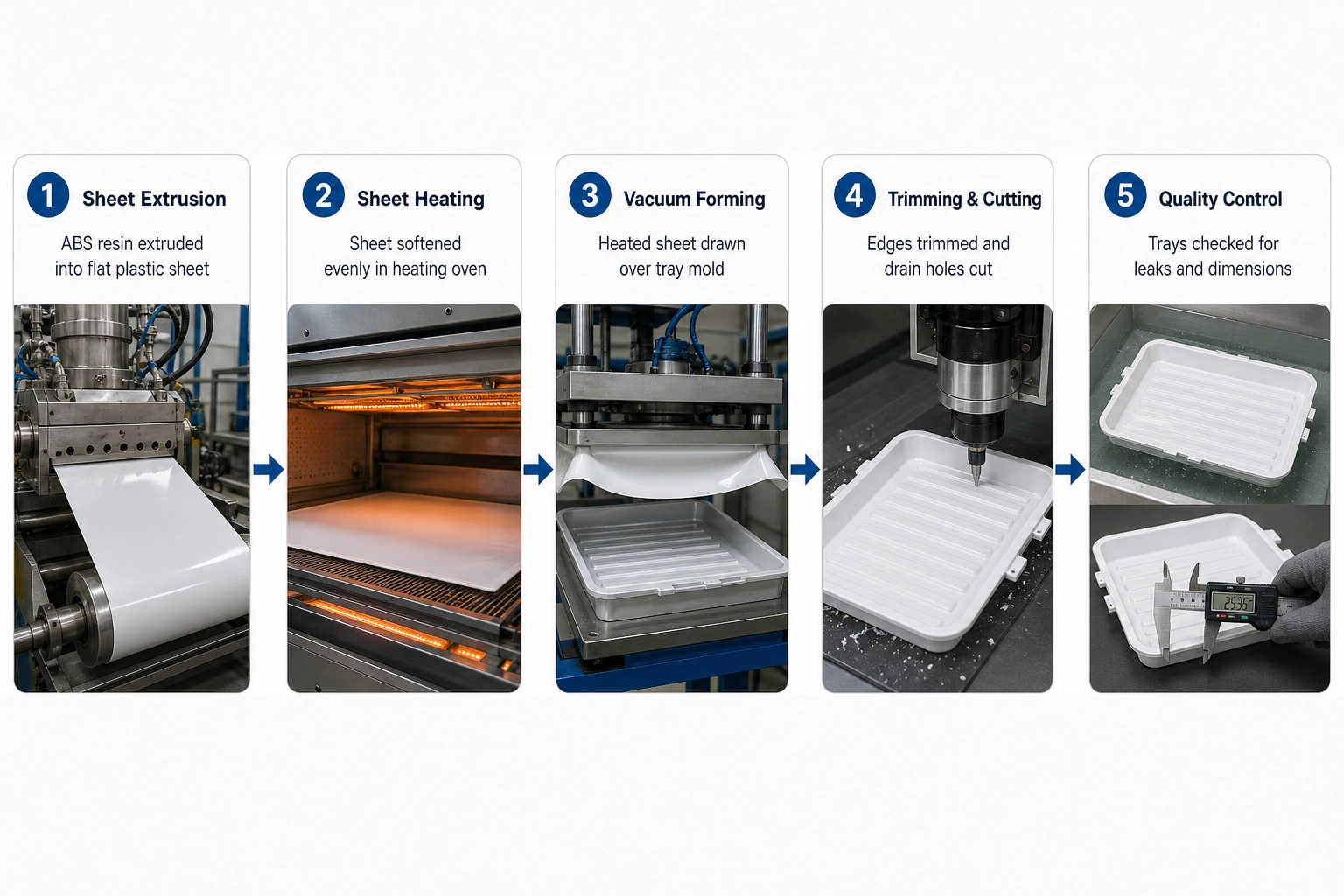
3. Why ABS? Material Advantages Over Alternatives
The tray material must survive three enemies: impact, UV, and chemical exposure (fertilizer salts and nutrient solutions). ABS is engineered for exactly this combination.
vs. general-purpose PP trays
- Higher rigidity and stiffness: ABS carries load with less flex at equal wall thickness; trays resist bowing under saturated media.
- Better dimensional stability and lower creep: ABS holds its flatness and shape under sustained load and greenhouse heat, whereas softer polymers can creep and sag over time.
- Superior surface hardness and scratch resistance: stacks, pots and benches mark ABS far less easily.
- Broader service temperature range: ABS retains toughness in cool climates while resisting distortion in hot, ventilated greenhouses.
vs. HIPS (high-impact polystyrene)
- HIPS is a common low-cost tray material, but ABS offers substantially higher impact strength and fatigue resistance, and better chemical resistance to nutrient solutions — an important factor where trays are handled, moved and reused for years.
vs. galvanized steel / aluminum benches
- Plastics eliminate corrosion, rust staining, sharp edges and the need for bench liners.
- ABS trays are lighter, easier to clean and replace, and simpler to reconfigure as crop layouts change.
- No electrolytic reaction with fertigation systems; fully compatible with plastic reservoirs and fittings.
ABS is also fully recyclable, and thermoforming offcuts are reground and reused in the extrusion process — a closed-loop production detail many growers now ask about.
4. Key Selling Points & Design Details
Beyond the raw material, the value of a tray lives in its design details:
4.1 Full, even flood — and complete drain
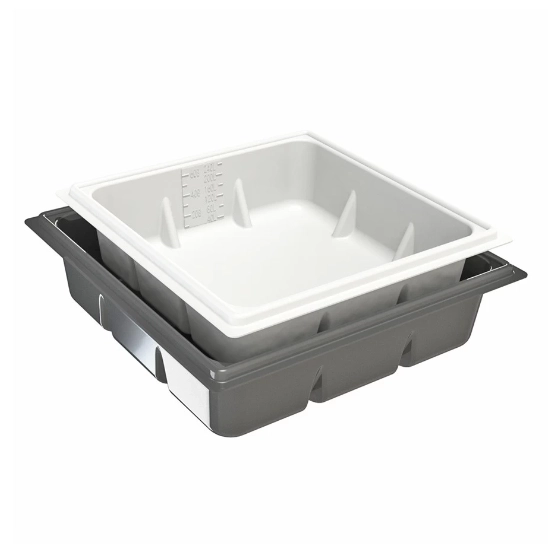
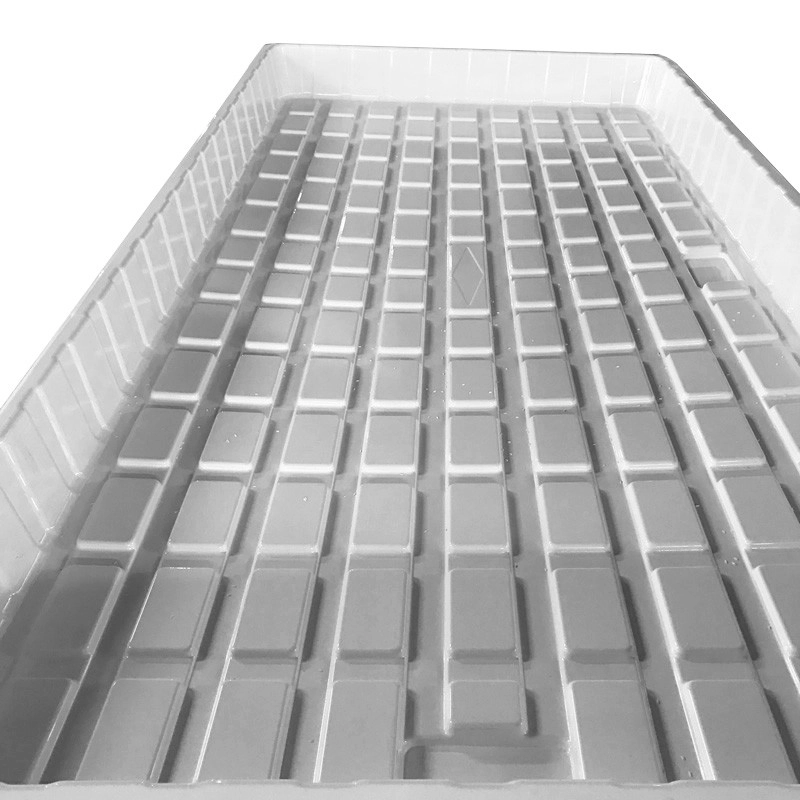
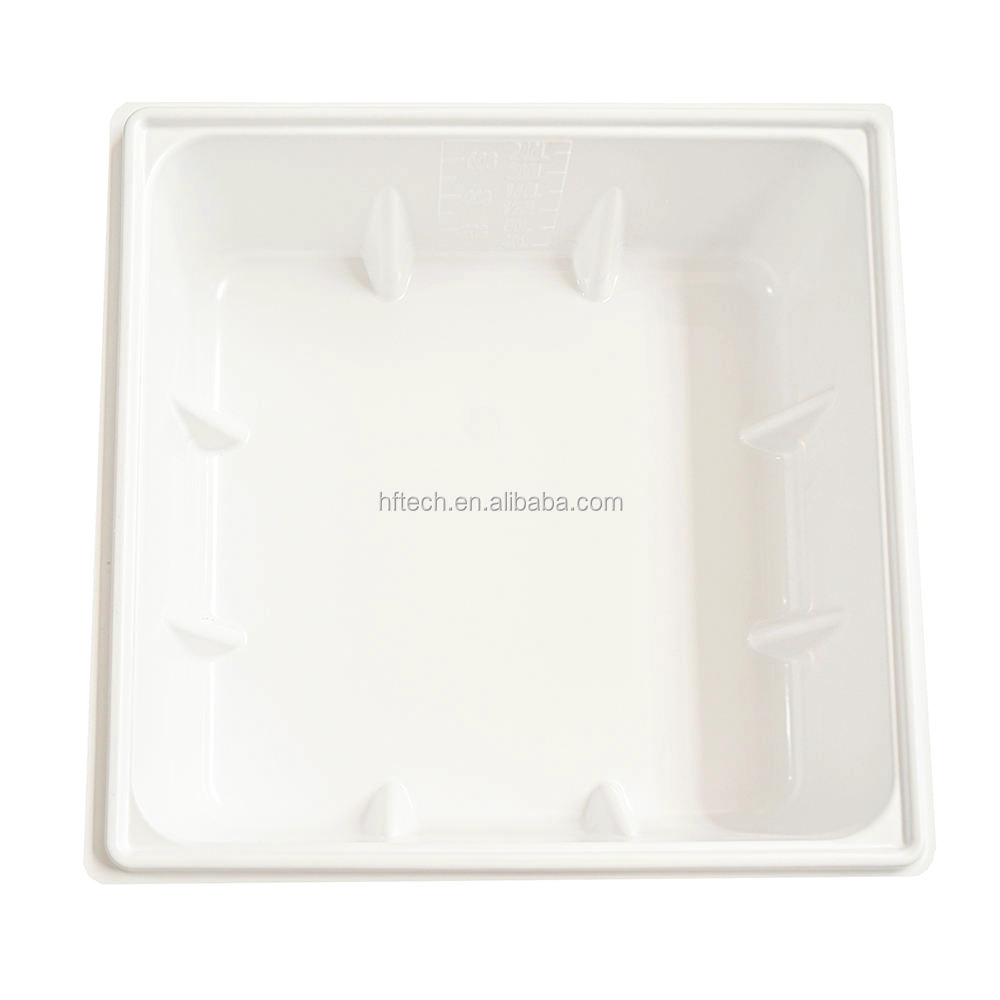
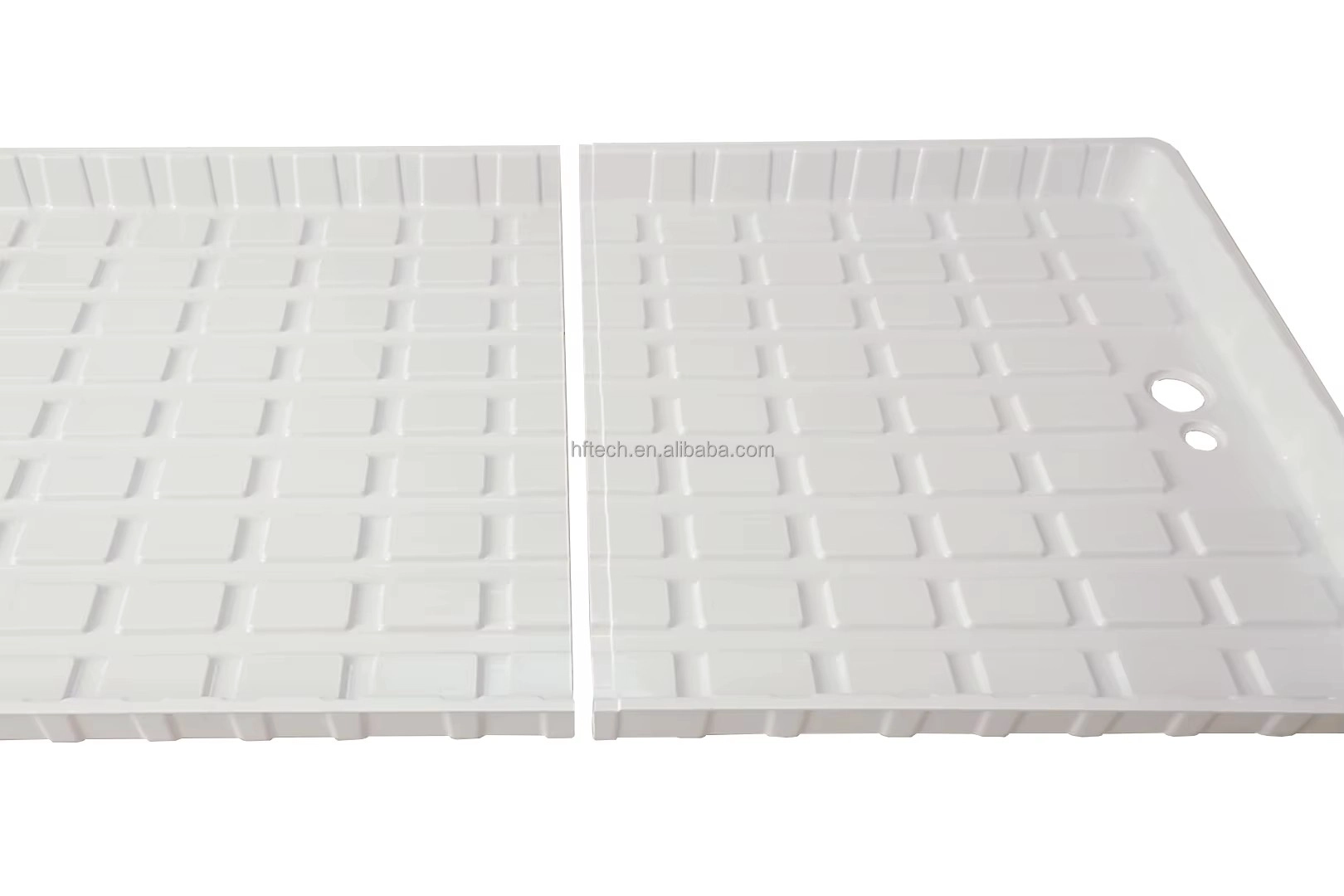
The bottom of every Yitian tray is engineered with a precision rib and slope layout that guides solution across the full footprint during flood and evacuates it completely on drain. No pooling, no dry corners, no dead zones where roots sit in stagnant solution.
4.2 Reinforced ribbed bottom for heavy loads
Deep, tapered ribs stiffen the floor so the tray supports saturated growing media, containers and mature crops without sagging or cracking. Rib spacing is optimized for the specific span, so load performance is engineered — not guessed.
4.3 One-piece seamless construction — guaranteed leak-free
Because the tray is vacuum-formed from a single ABS sheet, there are no seams or weld lines to fail. Every tray can be water-tightness tested before dispatch. Where extra-wide bench spans are required, tray modules can be joined end-to-end through molded interlocking tabs to build a continuous flood surface.
4.4 UV-stabilized, algae-resistant surface
UV stabilizers protect the tray from embrittlement under intense sunlight. A smooth, non-porous surface gives algae nothing to grip and wipes clean in seconds — important for crop hygiene and food-safety audits.
4.5 Safe, film-friendly edges
Edges are finished smooth or rolled so they will not puncture ground films, bench liners or irrigation lines — and will not cut gloved hands during handling.
4.6 Standard and custom drain fittings
Trays are available with pre-cut bulkhead openings in standard sizes, with matching fittings and seals supplied on request. Mount the fitting, connect your pump and reservoir — no special tools.
4.7 Nestable for economical freight
Trays are designed to nest, reducing shipping volume and freight cost on sea and air cargo alike.
4.8 Full customization (OEM/ODM)
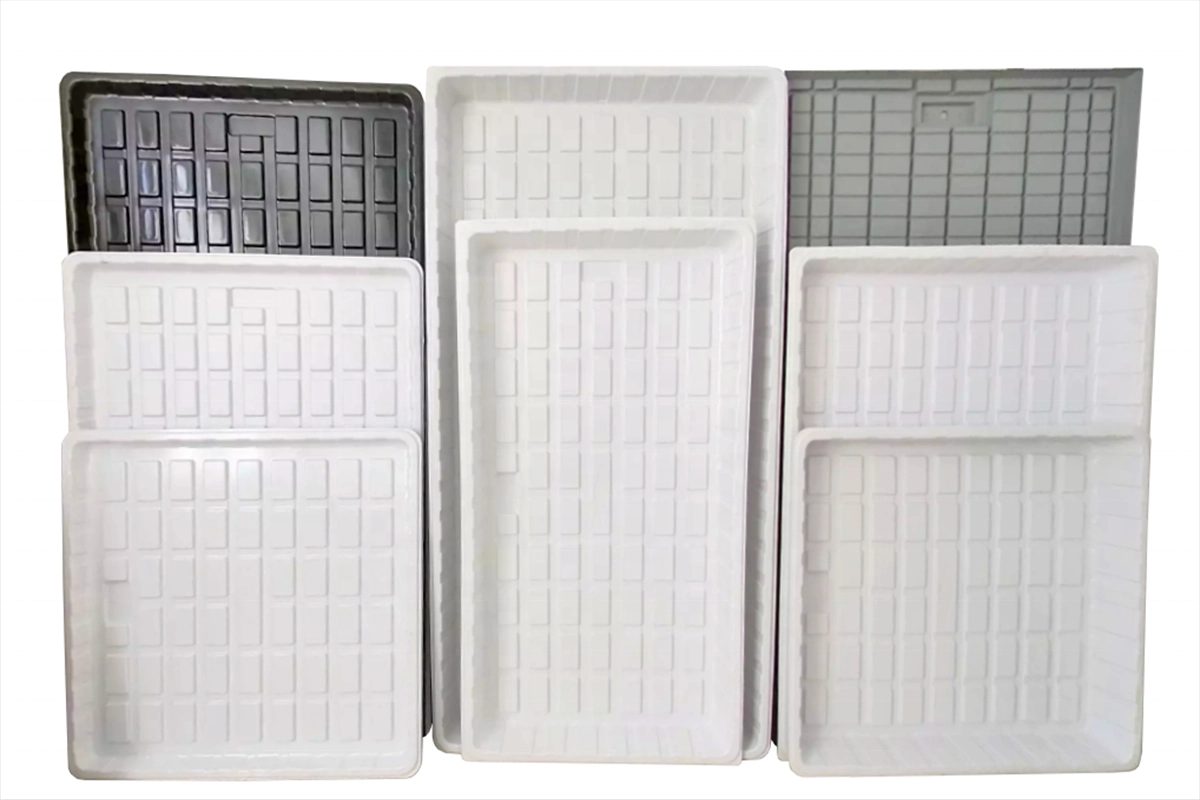
- Size and depth: tailored to your benches, racks, rolling tables or floor layout
- Gauge and rib pattern: tuned to your load and span
- Fitting positions: bulkheads placed exactly where your system needs them
- Color and branding: your logo, your color, your retail packaging
5. Applications
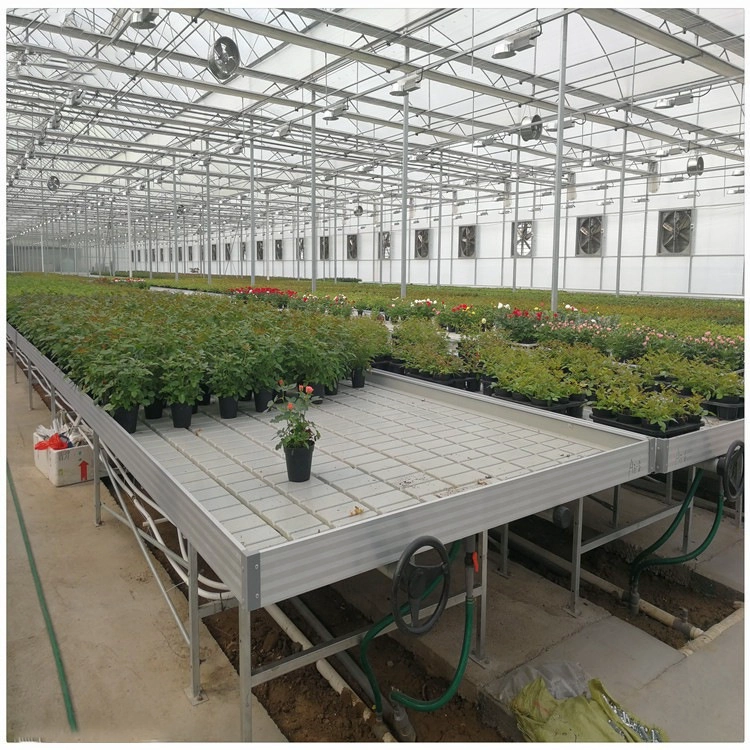
ABS ebb-and-flow trays are used across commercial horticulture:
- Greenhouse benching — potted ornamentals, bedding plants and vegetables
- Vertical farming and indoor growing — stacked flood tables on rack systems
- Nurseries and propagation — rooted cuttings, plugs and young plants
- Microgreens and edible crops — food-safe cycles, easy sanitation
- Research and education — controlled irrigation trials and teaching facilities
6. Frequently Asked Questions
Q1. What is an ebb-and-flow tray used for? -
It is a watertight basin used on a flood-and-drain irrigation cycle: a pump floods it with nutrient solution, roots soak from below, then the solution drains back to the reservoir. The tray delivers water, nutrients and oxygen to the root zone on every cycle.
Q2. Why choose ABS over PP or HIPS?
-
ABS combines high impact strength, rigidity and dimensional stability with good chemical and UV resistance. In practical terms: trays stay flatter under load, resist handling damage longer, and hold their shape through years of greenhouse heat and cold — while remaining fully recyclable.
Q3. What sizes are available?
-
Standard formats include 1020-style propagation trays, 2×4 ft, 2×6 ft, 4×4 ft and 4×8 ft bench trays with wall heights from 2" to 6" [confirm against actual product range]. Custom dimensions, depths and drain positions are our normal business — tell us your bench or rack layout.
Q4. How much weight can the tray hold?
-
Load capacity depends on tray size, wall gauge and rib configuration. Our engineers calculate deflection for your specific span and load, and production trays are verified by load testing. Send us your application and we will specify the right construction.
Q5. Will the tray leak?
-
No. It is vacuum-formed from a single ABS sheet — no seams or weld lines — and can be water-tightness tested before dispatch.
Q6. How do I connect it to my pump?
-
Trays can be supplied with pre-cut bulkhead openings in standard sizes, with matching fittings and seals. Mount the fitting, connect your tubing to the pump and reservoir — no special tools required.
Q7. How do I clean the tray between crops?
-
Rinse with water, then wipe with mild soap or a hydrogen-peroxide solution to control algae. The smooth, UV-stabilized ABS surface stays easy to sanitize for years.
Q8. Can trays be stacked for shipping?
-
Yes — the nesting design reduces shipping volume and freight cost. Trays are packed in reinforced cartons with edge protection for safe sea and air transport.
Q9. Do you support OEM/ODM and what is the MOQ?
-
Yes. OEM covers your logo, color and packaging; ODM covers custom sizes, depths and fitting layouts, with in-house mold development for fast tooling. MOQ and lead time depend on size and quantity — contact our sales team with your specification for a quote within 24 hours.
Q10. Can I get a sample before ordering?
-
Absolutely. Samples can be produced from existing tooling or a prototype mold for new designs, so you can test fit, load and chemical resistance on your own benches before committing to volume.
8. Partner with a Sheet-to-Tray Manufacturer
The difference between an ebb-and-flow tray that lasts one season and one that lasts ten is decided in two places: the material and the mold. As a manufacturer with in-house sheet extrusion, thermoforming and tooling under one roof, Yitian Plastic Products Co., Ltd. controls both.Send us your bench dimensions and crop plan — we will recommend the right size, gauge and drain configuration, and follow up with samples and a quotation within 24 hours.
- Other Products